PTF Impacts
Provost's Teaching Fellows have made lasting impacts in their departments, colleges and schools, all of the University of Texas, and even the broader scholarship of teaching and learning. Through both individual initiatives and university-wide programs, PTFs continue to serve as catalysts for positive change and further our campus culture of teaching and learning.
Displaying 1 - 25 of 25
Bilingual Training Program in Audiology (Digital Badge)
The majority of the clinical population served at the UT Speech and Hearing Center is Spanish-speaking, yet there is no audiology-specific training for students providing care. This program provides targeted training for audiology graduate students to best serve their Spanish-speaking patients. The culmination of this experience results in a digital badge provided by the Moody College of Communication, which can be viewed here.
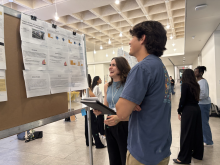
Applications of Data Science with City Datasets: Poster Session at UT Austin
On April 30, 2025, Guyot hosted a public poster session showcasing student projects focusing on datasets from the City of Austin Open Data Portal, held at the University of Texas at Austin. Projects ranged widely in focus, from environmental data to transportation and public safety, demonstrating the breadth of student inquiry and analysis.

Promoting the use of open data for data science projects (Open Data Day)
PTF Layla Guyot presented a session at Open Data Day in March 2024, hosted by the Austin Public Library. This event was part of International Open Data Day, which celebrates open government data with events hosted around the globe. Guyot presented about promoting the use of a local open data portal for data science projects with her collaborator, former student/current UGCA Dustyn Ransom.
New Courses Launched: General Chemistry Laboratory Courses CH104M and CH014N
In Fall 2024, PTF Ruth Shear helped launch the new general chemistry labs, rewritten to include Research Methods material (rebranded "thinking like a scientist"), and taught to 4500 students. This involved a complete overhaul of the CH204 general chemistry lab course, turning it into two classes: CH104M and CH104N. These courses are required for the vast majority of CNS majors as well as all pre-health students. The courses were piloted in Fall 2024 with 400 students, and fully launched in Fall 2025 with over 4500 students.
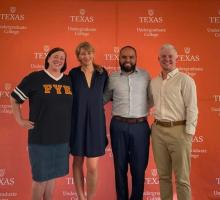
Be Well to Do Well (Signature Course Resource)
This video project was designed to be shown in all Signature Courses at UT. Together with a discussion prompt, the video aims to acquaint students with mental and physical health resources on campus, and to teach them strategies for success.
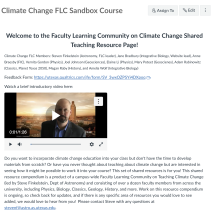
Teaching Climate Change (Canvas Module)
As part of Steve Finkelstein's PTF Initiative, a campus-wide faculty learning community constructed a canvas sandbox website where they could share materials related to climate change, with annotations, with the broader UT community. They collected the group's materials, and then tried to organize them in a useful way. The materials include lectures, activities, quizzes, projects, pre/post tests, etc., and are organized both by learning objective and by course. The website is now live, and a publication on pre/post survey results is being prepared.

Faculty Statistics Seminar (Texas State University)
PTF Layla Guyot gave an invited presentation at the weekly statistics seminar at Texas State University, to an audience of primarily faculty. In her talk Guyot discussed promoting the use of a local open data portal for data science projects.
City of Austin DIVE Meetup
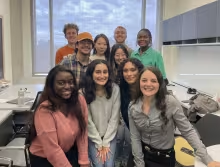
Nine students from PTF Layla Guyot's Elements of Data Science course were selected to virtually present the insights gained during their coursework to the Data, Impact, Visuals, and Exploration (DIVE) meetup organized by the City of Austin.

ClioVis: Visualizing Connections (Review, Journal of American History)
Dr. Jason Heppler of George Mason University reviewed ClioVis, the digital timeline visualization tool developed by Erika Bsumek, in the March 2024 issue of the Journal of American History. According to an excerpt from the review:
The Art of Mapping History (Life and Letters)
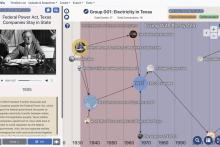
Life and Letters, the print and digital magazine of the UT College of Liberal Arts, featured ClioVis, the digital timeline visualization tool developed by Erika Bsumek's PTF initiative, in their November 2023 issue.
The Social Classroom (Chronicle of Higher Education)
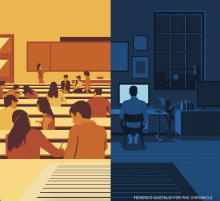
PTF Jen Ebbeler was interviewed for this article in The Chronicle of Higher Education about how professors can help their students connect and build relationships in both in-person and virtual classrooms, and explore the impact of student interactions on their learning.
Read the entire article here.

The Evolution of Peer-Assisted Learning: From SI to PLUS (ASEE)
Former PTF chair Nina Telang co-presented this paper at the American Society of Engineering Education (ASEE) Annual Conference in August 2022.

Supplemental Instruction (SI) Program for Electrical and Computer Engineering
For her Provost's Teaching Fellows initiative, Nina Telang developed of a Supplemental Instruction (SI) program in a sophomore-level Electrical and Computer Engineering course, EE319K: Introduction to Embedded Systems.
Supplemental Instruction (SI) study sessions to help students succeed in introductory courses by employing a peer teaching model. SI Leaders – TAs or peers who have already successfully taken the course – plan and lead two identical, voluntary SI sessions each week, which students can join at any point in the semester.
Implementation of a new student initiative: Promoting Student Success and Well-Being (ASEE Gulf-Southwest)
Former PTF chair Nina Telang co-presented this paper at the American Society of Engineering Education (ASEE) Gulf-Southwest Annual Conference in March 2021. This paper shares a detailed look into the implementation of a new student initiative focused on promoting student success and well-being.
Read the complete paper here, or find the abstract below.

ClioVis: Kendra Scott WEL Female Founder Competition Semi-Finalist and Crowd Choice Winner
The Kendra Scott Women's Entrepreneurial Leadership Institute (KS WELI) held the inaugural Female Founder Pitch Competition in October 2021.

Critical Literacies Project: ClioVis (UT System P20 Projects)
The UT System works with internal and external partners to foster critical literacies in students across the P20 continuum. UT institutions work to cultivate these literacies in students across traditional and emerging academic disciplines, and through partnerships and programs in PK12 schools, communities, and business and industry across Texas.

Thinking Critically with ClioVis (Pedagogy Playground)
Dr. Lindsey Passenger Wieck, faculty at St. Mary's University in San Antonio, Texas, reviewed ClioVis for the pedagogy blog Pedagogy Playground: Innovative Teaching in Higher Education in February 2020. The review discusses her experiences with ClioVis during and after a workshop led by Bsumek, and goes on to highlight the features of the tool which she finds most compelling: interactivity, collaboration, ease of use, exportability, and applications outside of coursework.
Qualitative and Quantitative Impact of Metacognitive Interventions in Supplemental Instruction Sessions (ASEE)
Former PTF chair Nina Telang co-presented this paper at the American Society of Engineering Education (ASEE) Virtual Annual Conference in June 2020.
Interview with Dr Erika Bsumek, the creator of ClioVis (Not Even Past, UT Department of History)
In September 2020 History faculty Adam Clulow interviewed Erika Bsumek for Not Even Past, the digital magazine of the UT Department of History, to discuss the development, use, and impacts of ClioVis, the digital timeline visualization tool created as part of Bsumek's PTF Initiative. This article is part of a wider series that explored how teachers and students across the History department, the university and world more generally responded in new ways to the unprecedented classroom environment faced in a time of global pandemic.
Digital Projects Enrich Undergraduate Research: ClioVis and Epoch (History Department News)
ClioVis, the digital timeline visualization tool created by Erika Bsumek as part of her PTF Initiative, was highlighted in UT Department of History News on May 25, 2020 by Dr. Megan Raby. The article explored the ways that ClioVis and Epoch, an initiative by History faculty Adam Clulow, are being used to create undergraduate research opportunities for UT liberal arts and history students.

Editor's Choice Award: ClioVis Description, Origin, and Uses (Digital Humanities Now)
"ClioVis: Description, Origin, and Uses," a September 2020 article from Not Even Past: the digital magazine of the UT Department of History, was awarded Editor's Choice by the online aggregate Digital Humanities Now.
Effectiveness of the Supplemental Instruction Program in First-Year Engineering Courses - A Longitudinal Report (ASEE)
Former PTF chair Nina Telang co-presented this paper at the American Society of Engineering Education (ASEE) Annual Conference in June 2019.

Drivers Exercise
Before deciding what your career goals are, it’s critical to know what you value most in a job. What gets you out of bed to go to start the day, go to work, and/or live your life? This exercise will help you define and prioritize what drives you. We provide definitions of 8 common "drivers". Once you understand these drivers, you can take the exercise and go through a ranking process to determine which are most important to you (i.e. you’re less likely to compromise on these) and which are less important (i.e. you’re more willing to compromise on these).

ClioVis Digital Timelines: Visualizing Connections
Erika Bsumek built the ClioVis digital timelines platform for instructors and students to build interactive digital timelines as part of their coursework or scholarly initiatives. The platform has been used by thousands of students across the US, including throughout the UT System, University of Michigan, Stanford, and others, in both humanities and STEM disciplines, as well as for research initiatives.

FromthePage, Crowdsourced Digital Archiving (UT Libraries Instance)
As part of his PTF Initiative, Adam Rabinowitz developed two UT resources for crowd-sourcing humanities archival and historical work and student “citizen science:" FromthePage (partnered with UT Libraries) and Nanosourcer (a Canvas plugin). UT’s customized FromthePage instance is permanently supported by UT Libraries, publicly available, and has nearly 1000 users working on over a dozen different archival collections.