PTF Impacts
Provost's Teaching Fellows have made lasting impacts in their departments, colleges and schools, all of the University of Texas, and even the broader scholarship of teaching and learning. Through both individual initiatives and university-wide programs, PTFs continue to serve as catalysts for positive change and further our campus culture of teaching and learning.
Displaying 1 - 10 of 10
Bilingual Training Program in Audiology (Digital Badge)
The majority of the clinical population served at the UT Speech and Hearing Center is Spanish-speaking, yet there is no audiology-specific training for students providing care. This program provides targeted training for audiology graduate students to best serve their Spanish-speaking patients. The culmination of this experience results in a digital badge provided by the Moody College of Communication, which can be viewed here.
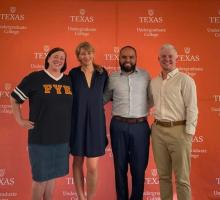
Be Well to Do Well (Signature Course Resource)
This video project was designed to be shown in all Signature Courses at UT. Together with a discussion prompt, the video aims to acquaint students with mental and physical health resources on campus, and to teach them strategies for success.
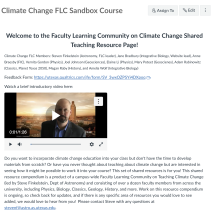
Teaching Climate Change (Canvas Module)
As part of Steve Finkelstein's PTF Initiative, a campus-wide faculty learning community constructed a canvas sandbox website where they could share materials related to climate change, with annotations, with the broader UT community. They collected the group's materials, and then tried to organize them in a useful way. The materials include lectures, activities, quizzes, projects, pre/post tests, etc., and are organized both by learning objective and by course. The website is now live, and a publication on pre/post survey results is being prepared.
New Courses Launched: General Chemistry Laboratory Courses CH104M and CH014N
In Fall 2024, PTF Ruth Shear helped launch the new general chemistry labs, rewritten to include Research Methods material (rebranded "thinking like a scientist"), and taught to 4500 students. This involved a complete overhaul of the CH204 general chemistry lab course, turning it into two classes: CH104M and CH104N. These courses are required for the vast majority of CNS majors as well as all pre-health students. The courses were piloted in Fall 2024 with 400 students, and fully launched in Fall 2025 with over 4500 students.

The Evolution of Peer-Assisted Learning: From SI to PLUS (ASEE)
Former PTF chair Nina Telang co-presented this paper at the American Society of Engineering Education (ASEE) Annual Conference in August 2022.

Supplemental Instruction (SI) Program for Electrical and Computer Engineering
For her Provost's Teaching Fellows initiative, Nina Telang developed of a Supplemental Instruction (SI) program in a sophomore-level Electrical and Computer Engineering course, EE319K: Introduction to Embedded Systems.
Supplemental Instruction (SI) study sessions to help students succeed in introductory courses by employing a peer teaching model. SI Leaders – TAs or peers who have already successfully taken the course – plan and lead two identical, voluntary SI sessions each week, which students can join at any point in the semester.
Implementation of a new student initiative: Promoting Student Success and Well-Being (ASEE Gulf-Southwest)
Former PTF chair Nina Telang co-presented this paper at the American Society of Engineering Education (ASEE) Gulf-Southwest Annual Conference in March 2021. This paper shares a detailed look into the implementation of a new student initiative focused on promoting student success and well-being.
Read the complete paper here, or find the abstract below.
Qualitative and Quantitative Impact of Metacognitive Interventions in Supplemental Instruction Sessions (ASEE)
Former PTF chair Nina Telang co-presented this paper at the American Society of Engineering Education (ASEE) Virtual Annual Conference in June 2020.

Drivers Exercise
Before deciding what your career goals are, it’s critical to know what you value most in a job. What gets you out of bed to go to start the day, go to work, and/or live your life? This exercise will help you define and prioritize what drives you. We provide definitions of 8 common "drivers". Once you understand these drivers, you can take the exercise and go through a ranking process to determine which are most important to you (i.e. you’re less likely to compromise on these) and which are less important (i.e. you’re more willing to compromise on these).
Effectiveness of the Supplemental Instruction Program in First-Year Engineering Courses - A Longitudinal Report (ASEE)
Former PTF chair Nina Telang co-presented this paper at the American Society of Engineering Education (ASEE) Annual Conference in June 2019.